
The Womanosphere — The Quiet Unraveling of Women’s Rights
Recently, I read the worldwide bestseller Yesteryear. It’s not the kind of book I usually pick up, but curiosity got the better of me — I wanted to understand the hype.
Well. Aside from the ending (was there truly no other option?), it was entertaining enough. What surprised me most was that it touched on contemporary issues, though gently. A few days after finishing it, I learned the story was loosely inspired by a real “tradwife.” She lives on a place called Ballerina Farm, is married to an incredibly wealthy man, has eight children, and — hold on to your hats — twenty million Instagram followers. And of course, she bakes her own bread. A key credential, apparently.
In all honesty, I was late to the party. I had no idea “tradwives” existed, no idea women were choosing this lifestyle, and certainly no idea they had such massive followings — or such lucrative business models built on their “traditional” lives.
Then today, I stumbled upon an article about the womanosphere, a term coined by feminist media researcher Jilly Boyce Kay. And let me confess: I wasn’t just late to the party; I didn’t even know there was a party. The womanosphere — or femosphere — is an entire ecosystem of its own. Not cohesive, but sprawling across platforms, aesthetics, and cultural frameworks, creating a distinctly different online world.
The name might echo its counterpart, the manosphere, but the two operate very differently. Where the manosphere frames gender equality as an attack on men and treats women as lesser beings, the womanosphere takes a softer route. It romanticizes femininity. The trouble is how it defines femininity: not as a spectrum of identities and choices, but as something “natural,” fixed, and rooted in a narrow vision of womanhood.
You might ask: What’s wrong with that?
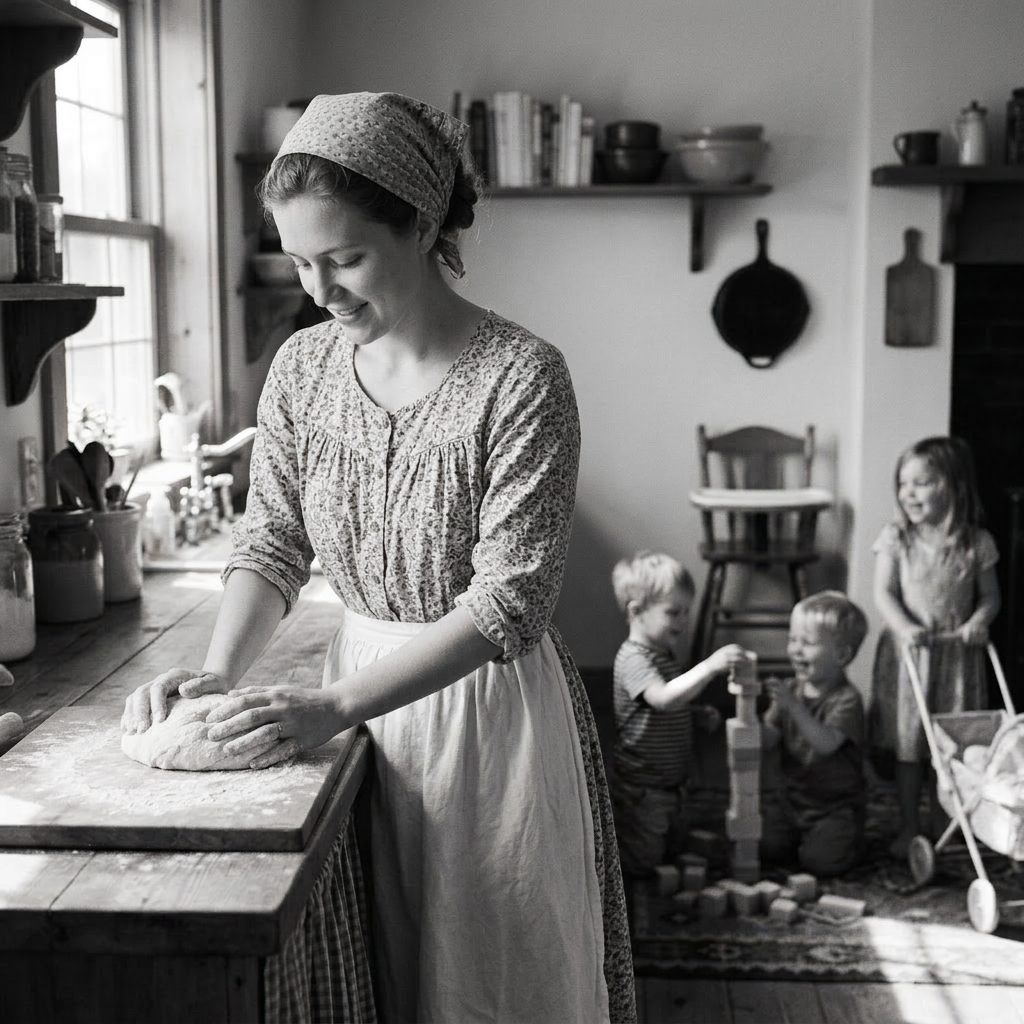
This version of womanhood idolizes a single model of family, motherhood, and “values.” Women in their “natural” roles: stay‑at‑home mothers, cooking “real food,” homeschooling their children, glowing with domestic bliss like a 1950s advertisement.
And make no mistake — it is an advertisement.
The men of the manosphere preach. They argue, persuade, recruit. The women of the womanosphere are far more strategic. They don’t tell you how to live; they show you. TikTok, Instagram, Facebook — all filled with beautiful, slender women with glossy hair kneading dough at dawn, smiling beatifically over eight children, demonstrating how to churn butter and make jam while looking effortlessly wholesome. Testimonials about perfect marriages and perfect homes. Who wouldn’t want that?
But here’s the truth: these women are married to extremely wealthy men and, perhaps more importantly, run highly profitable businesses built on their “traditional” image. They are not nearly as traditional as they claim. If they were, they wouldn’t be monetizing the lifestyle.
Beyond the curated aesthetics, the message is unsettling:
Working and raising kids is too hard.
You’re depriving your children by having a career.
You don’t need education or financial independence.
A man will take care of you.
He’ll even vote for you.
All you need is good makeup, a curling iron, and a handsome husband, and life will smell like roses.
Gone are the rights my mother fought for. Gone is the conviction I passed on to my daughters — that education, a work ethic, and confidence give you options. Not because a diploma hangs on the wall, but because knowledge and independence create freedom. The freedom to leave situations you don’t want to be in. The freedom to build a life you choose.
Most women in the world don’t have the privileges my daughters do. Many live in countries where women are treated as second‑class citizens, where girls are barred from school, where women have no rights, no healthcare, no financial autonomy. Even in so‑called “first world” countries, many women live below the poverty line, raising children in impossible circumstances.
For a century, women — and men — have worked to improve women’s lives: access to education, healthcare, leadership, careers. Is it easy? No. Not in my day, not in my daughters’. Is it fulfilling? Yes.
This conversation takes me back to my childhood. My mother was initially a stay‑at‑home mom because that was expected. Even as a child, I saw her unhappiness — a bright woman distributing milk at school when she longed for intellectual challenge. When we were teenagers, she returned to work. I still remember her coming home, animated, laughing, telling us stories from her day. She grew. She thrived. She was happy.
Some women choose to stay home. Some choose to work. Sometimes it’s not a choice at all. The point is: women should have choices. We should want women to live in the 21st century with the freedom to pursue the lives they envision. I believe deeply in encouraging people to reach for the metaphorical brass ring — and in building a world where women (and men) are supported in doing so.
That is my objection to the womanosphere and the tradwife aesthetic: it sells a life that narrows women’s possibilities, erodes their autonomy, and romanticizes a past where women had no choices at all.
So yes, I may have been unaware there was a party. And yes, I arrived late. But I’m aware now. And I hope others will see this movement for what it is: a slow, seductive unraveling of women’s rights.
Maybe it’s time we crash that party.
Waiting for Humanity to Kick In

It’s been a while since I’ve written anything. Not because the need disappeared, but because life has simply been too much while trying to navigate a chronic illness. At least, that’s the explanation I kept giving myself.
Yes, I’ve been tired — deeply tired — but I’ve also been frustrated by what’s happening in the world. There were weeks when I couldn’t bring myself to read the newspaper or watch the news. How many images of dead children can one absorb? How much war, how much grief, how much hardship falling upon others before something inside you quietly shuts down? At a certain point, I felt emptied out by what life was presenting.
And yet, at my core, I am an optimistic person. That optimism has been fighting an uphill battle, but after many months of fatigue and lost hope, that small, stubborn voice has resurfaced. I can’t point to a single event that explains the shift — nothing in the world has improved dramatically — but still, something in me has lifted.
So what does the optimistic version of me have to say after all these months? Not much that can be backed by airtight reasoning. Sudan remains a hellscape. Democracy in the U.S. continues to erode inch by inch. European leaders seem to be retreating into their foxholes, determined to protect “their own” while the great powers toss diplomacy out the window. Prices are up, people everywhere are struggling to pay their bills, and most of us are quietly worried about the state of things.
Is this optimism, then, simply a form of deep hope rather than true optimism? Perhaps. Not because I want to dampen anyone’s spirits, but because — for the first time in my life — I genuinely wonder whether we’ve crossed an invisible line that once kept us anchored to morality.
History has seen this before: the world slipping off its axis, becoming unsafe and unpredictable before it eventually rights itself again. Humanity has always managed to bounce back. Even now, I believe morality will win in the end. The question is: when will that end arrive? How many years must we endure before we collectively remember our capacity for humanity?
I imagine many people during the World Wars — and countless other times of devastation — also lost sight of the finish line. Yes, there were always those who believed in humanity’s potential, who stood up and fought for a world grounded in respect and compassion. Perhaps my current loss of optimism stems from the absence of such leaders today.
Who do we turn to for relief? Who stands at the forefront demanding a safer, kinder world for all? Who has the moral authority to call the dissidents to order? Who can inspire us to be neighbors again — to care for one another without expecting anything in return? When will we remember that true power lies in seeing beyond our own needs and prioritizing the wellbeing of every individual, regardless of gender, religion, or heritage? What is the human race worth if we cannot even care for our own?
My dwindling optimism is also shaped by my recent experiences. So many people are overwhelmed — often for understandable reasons — and unable to muster the compassion they once had. It feels as though we’ve all been sealed inside our own bubbles: aware of what’s happening outside, but no longer touched by it. We’re focused solely on maintaining our own supply of oxygen.
So I will wait. I will wait for the bubbles to burst, for someone to rise and guide us back toward our shared humanity. And until then, perhaps I should write again — if only to remind myself of my own need for compassion in this world. I hope there are enough like‑minded souls among you, dear readers. If only so I don’t feel quite so alone.


You must be logged in to post a comment.