
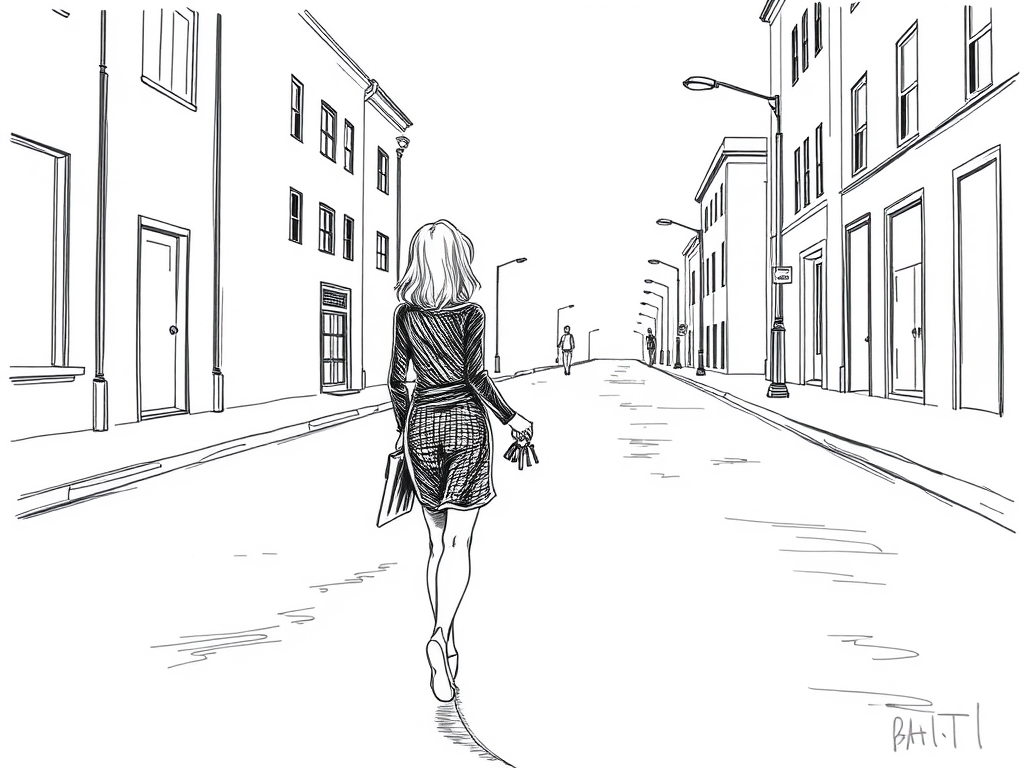
This month, Dutch research bureau CBS (Centraal Bureau voor de Statistiek) published findings on gender differences in perceived safety. Almost half of the young female population (ages 15 to 25) report taking alternative routes home to avoid ‘unsafe places.’ Even among older women, the numbers remain substantial, with 30% of those aged 65 and up doing the same. Men, by comparison? Around 20%—across all age groups. In addition, 45% of all women say they fear becoming a crime victim in their own neighborhood.
These numbers were considered newsworthy in the Netherlands, as they should be. When nearly half of the female population doesn’t feel safe in their own streets—and even change their route home to avoid danger—there’s a problem.
Yet even acknowledging the severity of these statistics, I find them low. Most women I know don’t feel safe on the streets, especially in the dark or when walking alone. We know to keep our keys ready—for quick entry or as a weapon. We’re taught to yell “fire!” instead of “help!” because people are more likely to respond. We plan our routes, steer clear of tricky areas, let men pass when they’re behind us, glance into shop windows to check who’s nearby, and constantly assess risk. It’s second nature. Given all that, 45% feels like an understatement.
That got me wondering—what are the numbers in other countries?
According to Gallup’s 2023 Crime Survey, over 50% of women in the United States report feeling unsafe walking alone at night, compared to just 25% of men. Studies show that women tend to scan for dangers like bushes and dark corners, while men focus on the path ahead. In Great Britain, 63% of women feel unsafe walking alone at night, with the 18–25 age group scoring remarkably high at 81%. Parks and open spaces after dark? Around 80% of British women say they feel unsafe.
In Germany, 48% of women feel unsafe in their own neighborhoods. In France, surveys show 54% of women feel unsafe walking alone at night. Australia sits at 40%. In India, a startling 79% of urban women report harassment or violence in public spaces, and Brazil tops the list with 89%.
So what about Scandinavia—known for progressive gender policies and high levels of gender equality?
In Sweden, 34% of women say they feel unsafe walking alone at night. In Denmark, that number is 22%, and Norway reports just 13%. On an emotional level, any percentage is too high, but statistically speaking, women in Scandinavia perceive less danger than those in the rest of Europe, the U.S., or the Global South. Why?
Many government reports point to cultural and societal norms. In countries with entrenched patriarchal structures and gender inequality—like India and Brazil—harassment and violence are more frequent. Even in places with legal gender equality, such as Western Europe and North America, underlying cultural attitudes still shape both violence and the fear it instills.
This theory may explain Scandinavia’s relatively low fear levels, where women enjoy both legal rights and cultural equality. According to The Perspective, Northern European women have higher trust in law enforcement and stronger support systems. This encourages reporting and reduces anxiety. When you believe the police will take you seriously—and the courts will hold attackers accountable—you naturally feel safer. It may also discourage violence in the first place.
That said, Scandinavia isn’t without contradictions. The so-called ‘Nordic Paradox’ refers to the relatively high rate of intimate partner violence in these countries despite their strong gender equality. Some researchers suggest that female empowerment can provoke backlash from entrenched masculinity norms. A girl just can’t catch a break.
“Creating equality for women doesn’t mean diminishing men’s worth.” — Equality isn’t a zero-sum game
The Path Forward
Can public policy help shift these numbers? In theory, yes. Governments have invested in safer infrastructure—better lighting, expanded CCTV—and educational efforts that promote respect and gender equality. Safety charters, community patrols, and venue staff training programs have all been introduced. While these efforts have raised awareness, many studies show that actual safety statistics haven’t improved much.
The truth is this: female safety—at home and in public—is a real issue. Statistically, crime against women is substantial. These realities fuel the fear women feel, especially in quiet areas and after dark. That fear isn’t irrational—it’s based on experience, and often passed down from mother to daughter. We’re taught early on to fear sexual assault, physical violence, and emotional abuse. By the time we’re grown, it’s second nature. We don’t like it, we don’t accept it, but we’ve learned to live with it.
So here’s my question to societies around the world: when we hold the next baby girl in our arms, do we really want the first message she receives to be one of fear? To be afraid of the dark, afraid of strangers, afraid to walk through her neighborhood alone? To be afraid of the world for the rest of her life?
Not in my world.
“You are beautiful, you are smart, and you are worthy of a life without fear.” — What every girl deserves to hear
In my world, we say: you are beautiful, you are smart, and you are worthy of a life without fear. We teach boys that empowering girls doesn’t mean shrinking themselves. We teach men that love and respect are stronger than hate and violence. And we push governments to act when violence does occur—to prosecute, to protect, and to prevent. We aim for a world where keys are meant for opening doors and not as weapons.
We refuse to accept anything less.
Who wants to join me in my world?
If you enjoy reading my insights and would like to stay updated on my latest posts, please subscribe to my blog for email notifications. Subscription is free!
 RosieGlobal
You must be logged in to post a comment.