
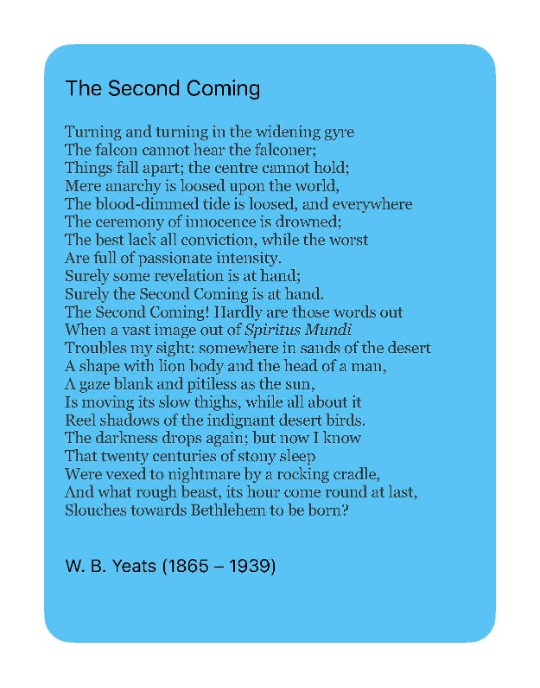
W.B. Yeats penned the poem “The Second Coming” in 1919, in the aftermath of the flu pandemic of 1918-1919 and the devastation of World War I. First published in 1921, his work emerged during a tumultuous era, witnessing the beginnings of the rise of fascism, political decay in Eastern Europe and a time of disenchantment in certain parts of Europe.
Yeats’s poem, steeped in prophetic imagery, hints at a seismic shift in history—a tumultuous turning of gyres that heralds the dawn of a new epoch. However, unlike the connotations associated with the Christian notion of “Second Coming,” Yeats subverts the term to foretell a troubling future. He envisions a world where the foundations of society crumble, where humanity stands paralyzed in the face of a tidal wave of destruction and chaos.
Believing in the cyclical nature of history, Yeats posits that by examining the past, we might discern patterns that resonate in our own time. As we look around, it becomes unsettlingly clear: we are on the verge of revisiting the echoes of the post-World War I era. The signs are alarming. We continue to grapple with the lingering effects of the recent pandemic, while simultaneously witnessing a pervasive rise in discontent—a fracturing of social cohesion as individuals increasingly define themselves by race, gender, and belief systems. These identities, rather than fostering community, often become barriers, isolating ‘the other’ who fails to conform to their narrow viewpoint.
The manifestation of this discontent is alarming. Some citizens are erroneously attributing economic decline to minorities and undocumented immigrants, suggesting that societal decay stems from the so-called contamination of culture by ‘the other.’ Alarmingly, political narratives in many Western nations are shifting to empower these sentiments, as the hunger for power grows insatiable.
“The best lack all conviction, while the worst are full of passionate intensity.”
Simultaneously, we witness a troubling decline in voter participation. Many people are disengaged, weary of empty political rhetoric that fails to resonate with their experiences. Those who raise alarms about the darkening clouds on the horizon are often ignored, dismissed as false prophets or likened to the proverbial boy who cried wolf. The masses overlook the nuanced tempo at which societal changes unfold; smaller shifts may ignite immediate public outcry, provoking intense discussions and eventual acceptance, while larger, more significant transformations occur gradually, nearly imperceptibly, until they are undeniable.
This reflection bears urgency as I publish this piece on International Holocaust Remembrance Day. Imagine if, in 1930, a German citizen had been told that merely a decade later, their nation would orchestrate the deaths of one million Jews, homosexuals, and Romani people. They would likely have scoffed, branding such claims as absurd. Likewise, had they been informed that they would need to hide people from a German army intent on dragging them to gas chambers, they would have recoiled at the thought.
Yet here we stand, confronted by chilling similarities. The President of the United States has ordered the rounding up of undocumented immigrants, tearing children from schools and patients from hospitals, invading homes that provide sanctuary for the hunted. Recently, we’ve witnessed a rejection of those who do not conform to rigid identity frameworks—DEI (Diversity, Equity, and Inclusion) policies rolled back by major corporations, military reconfigurations sidelining transgender troops, and tariffs used as leverage to manipulate global policy.
The troubling conditions we observe are not confined to the U.S. The rise of extreme nationalist parties is evident in Britain and across EU nations. The horror of extremism erupting in Israel on October 7, 2023 is embedded in our memories. Let us not forget the plight of the Palestinians, who have suffered for decades—losing homes, families, and lives. Countries reinstating the death penalty further emphasize a descent into brutality, and the reality that 92 nations are involved in foreign conflicts serves as a stark reminder of our global distress.
Disenchantment pervades the lives of citizens worldwide. Faith in democratic systems, values, and their representations is eroding. The soaring costs of food, housing, and healthcare are straining ever-larger populations. Access to these essentials grows increasingly elusive. Many seek solace in isolation, embracing homogeneity by exiling those who look or think differently—extracting foreign influences that, they believe, disrupt their well-being and hinder their nation’s growth. In this environment of discontent, more individuals are drawn to extremism as their voices go unheard.
Some argue that today’s disenchantment pales in comparison to that of the 1920s and 1930s. We have learned from our mistakes, they say; we are not like “those people.” We will not become as they were.
I hope for a future where we do not look back and wonder, “Could we have seen it coming?”. “It took time for the current situation to evolve, yet were there not signs indicating we were losing our sense of humanity?”. Ask ourselves whether the lives lost could’ve been prevented.
It is a grim inquiry, but one that must be addressed now: Are we losing our moral compass? Is humanity in peril?
Or has the gyre already shifted, leaving us to await the arrival of a lion’s body with the head of a man?
 RosieGlobal
You must be logged in to post a comment.